Skip to content
← All applications

Protein Labelling

Small molecules such as fluorophores, biotin or click chemistry handles add new functions to proteins, allowing them to be tracked, quantified or immobilized.

Experimental data

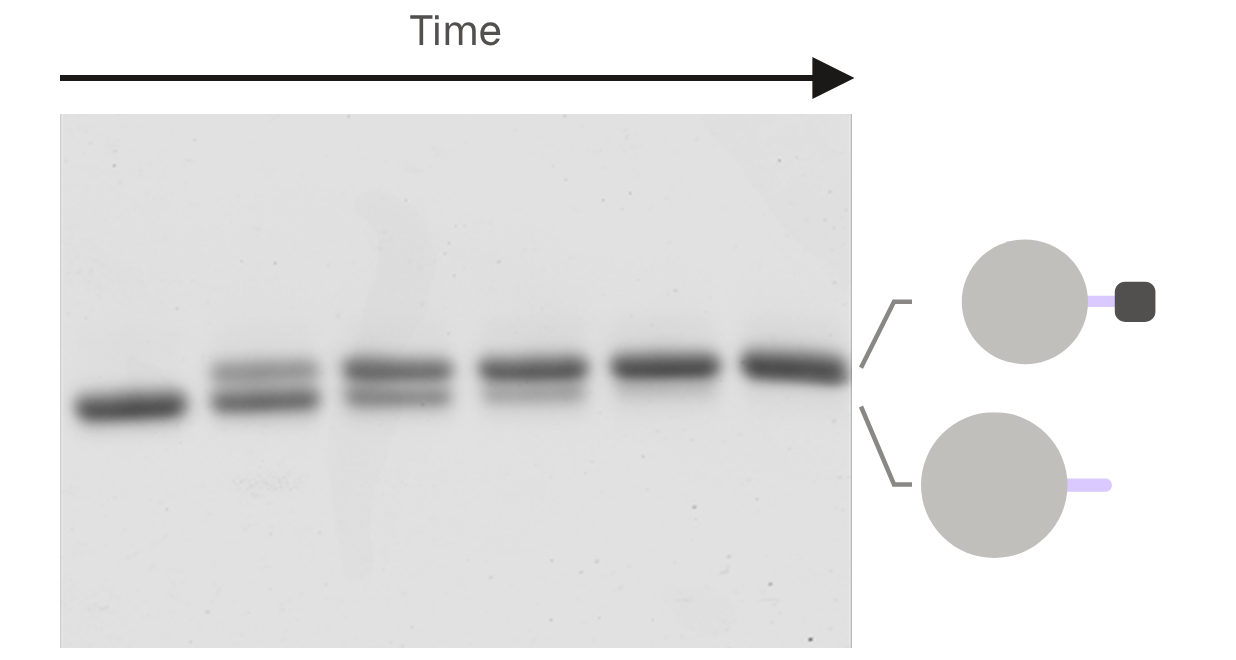
SDS gel of a biotinylation over time
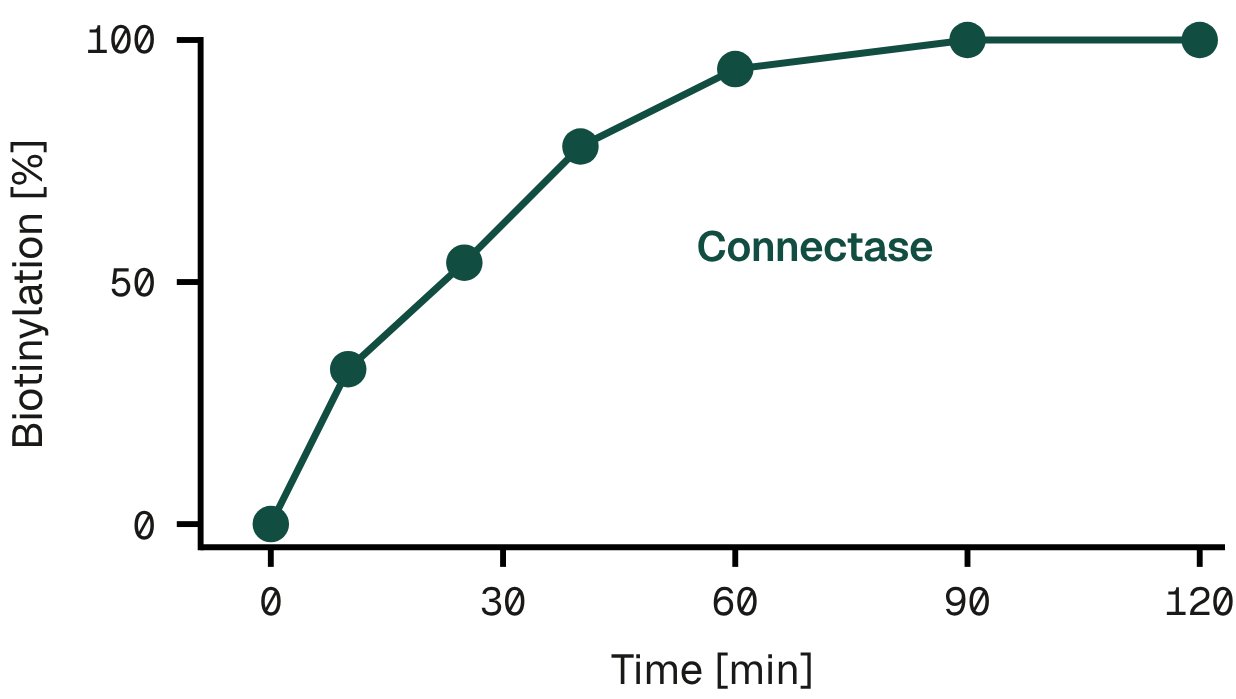
Biotinylation over time

a SDS gel of a biotinylation reaction. The tagged protein (lower band) is converted into the biotin-labelled protein (upper band).b Quantification of biotinylation over time.

How to use

  1. Produce a Lock- or Key-tagged protein.

  2. Mix it with the labelling reagent and the Connectase ligation reagent.

  3. Incubate for 1 hour.

Lock-Tag
ELASKDPGAFDADPLVVEI
C-terminal, 19 aa
Key-Tag
AGAFDADPLVVEI
N-terminal, 13 aa

FAQ

How can I use Connectase to conjugate my protein?
You need to produce your protein recombinantly, with either a C-terminal Lock-Tag (ELASKDPGAFDADPLVVEI) or an N-terminal Key-Tag (AGAFDADPLVVEI). The recombinant protein can then be mixed with Connectase and a suitable conjugation partner.
Do I need a spacer between the tag and my protein?
For sterically demanding proteins, we recommend an extra arginine (R) N-terminal to the Lock-Tag and two extra alanines (AA) C-terminal to the Key-Tag. Many other conjugations work efficiently without any additional linker sequence.
Which buffers does Connectase work in?
Connectase works over a wide pH and salt range and tolerates common additives such as detergents and chaotropes. It has no special buffer requirements.
How long do I need to incubate?
Most reactions are finished after about one hour at room temperature. Higher temperatures speed up the reaction.
Do I need to remove the enzyme after the reaction?
In most cases, no. Connectase is used at low concentrations and catalyzes nothing beyond the conjugation. Where removal is needed, its His-tag allows capture on Ni-NTA resin.

See all FAQs

Try it in your own lab