Skip to content
← All applications

Protein Detection

Protein detection in complex samples is a key laboratory application, allowing researchers to determine when and where proteins are made and how they function.

Connectase links a fluorescent label to Lock- or Key-tagged proteins directly in cell lysates and other complex samples, so they can be detected and quantified by in-gel fluorescence on an SDS gel, without antibodies or blotting. The detection reaction takes ten minutes and requires only a standard SDS gel and a fluorescence imager, giving quantitative results faster than Western blotting.

Experimental data

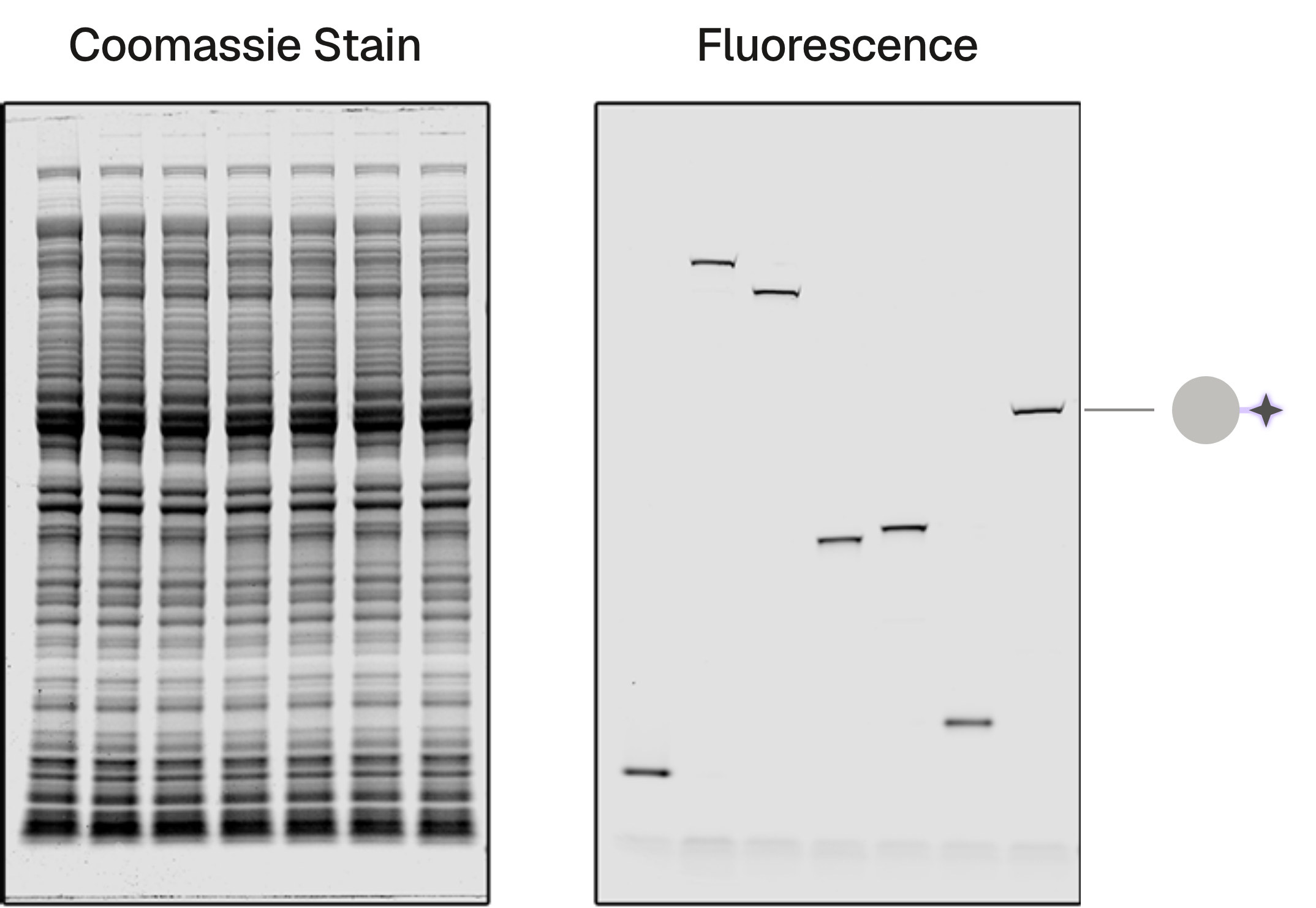
The same SDS gel with Coomassie stain and with Connectase fluorescence detection
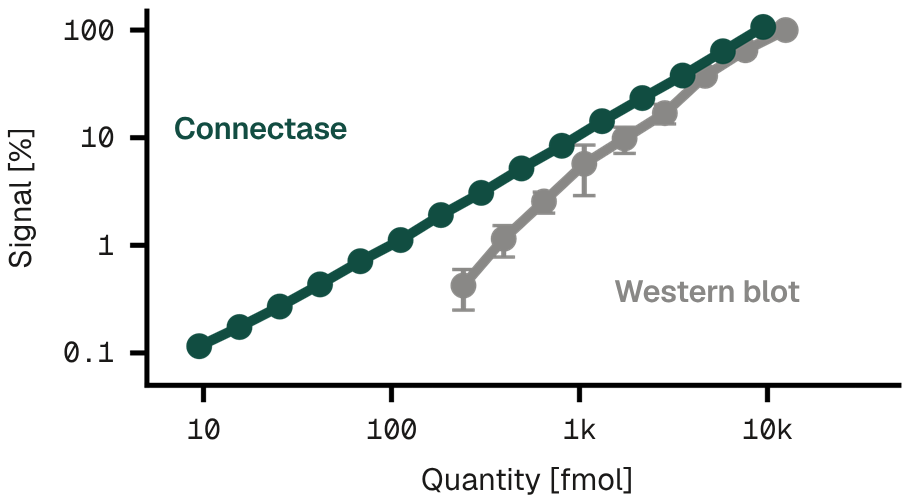
Signal versus protein quantity for Connectase detection and Western blot

a The same gel stained for total protein (Coomassie stain, left) and imaged for fluorescence (right). Each protein is detected as a clean and sharp band of similar intensity.b Connectase detects proteins with a strictly linear signal-to-substrate relationship, enabling more accurate quantification than Western blots.

How to use

  1. Start with any sample containing Lock- or Key-tagged proteins.

  2. Mix it with the detection reagent and incubate for 10 minutes.

  3. Run an SDS gel and visualize it on a fluorescence imager.

Lock-Tag
ELASKDPGAFDADPLVVEI
C-terminal, 19 aa
Key-Tag
AGAFDADPLVVEI
N-terminal, 13 aa

FAQ

Do I need a spacer between the tag and my protein?
For sterically demanding proteins, we recommend an extra arginine (R) N-terminal to the Lock-Tag and two extra alanines (AA) C-terminal to the Key-Tag. Many other conjugations work efficiently without any additional linker sequence.
Which buffers does Connectase work in?
Connectase works over a wide pH and salt range and tolerates common additives such as detergents and chaotropes. It has no special buffer requirements.
How can I quantify my protein?
We supply a defined protein standard that you can add to your sample. The signal ratio between the standard and your protein then gives you the protein concentration.
Which fluorophores can be used for the Protein Detection assay?
We currently supply Cy5.5 (Ex/Em ≈ 675/694 nm) and Cy5 (Ex/Em ≈ 649/667 nm) and plan to expand the set of fluorophores in the future.

See all FAQs

Try it in your own lab